
Diamond turning is a machining process that cuts a precision surface with a single crystal diamond tool, and it exists because some surfaces and forms are too precise for conventional machining to hold. The name is a common source of confusion, so it helps to start with the standard definition of diamond turning: turning that uses a cutting tool with a diamond tip, carried out on lathes or derivative machine tools fitted with natural or synthetic diamond-tipped tool bits (Wikipedia, Diamond turning, retrieved 2026). The same source notes that the term single-point diamond turning, or SPDT, is often applied, though the "single-point" label is sometimes only nominal, since radiused tool noses and contoured form tools are also options.
A short definition pitched at a general engineering audience puts it more simply: the workpiece is secured to a lathe and rotated against a stationary cutting tool, and the only real difference from ordinary turning is that the tool is diamond-tipped rather than steel, titanium or another metal (Monroe Engineering, What Is Diamond Turning?, 2019-11-07). What that buys you is surface quality. The peer-reviewed range for diamond-machined surface roughness sits at roughly 1 to 10 nm Sa, a process-class range rather than a guarantee for any given part.
This article covers how the process works, which inputs decide the finish and form accuracy you actually get, where diamond turning stops working, and how it compares with grinding, polishing and molding.
Diamond turning is turning with a cutting tool tipped in diamond, used to machine precision parts on a lathe or a derivative machine tool. That is the standard definition of diamond turning, and it covers both natural and synthetic diamond tool bits (Wikipedia, Diamond turning, retrieved 2026). The surfaces it produces come off the machine with high specular brightness and need no additional polishing.
The term single-point diamond turning (SPDT) is often applied to the process, though as with other lathe work the "single-point" label is sometimes only nominal, since radiused tool noses and contoured form tools are also options. Most SPDT today runs on CNC machine tools.
Key Takeaway: Diamond turning machines a part with a diamond-tipped tool on a precision lathe, and on compatible materials it leaves an optical surface that requires no polishing afterward.
"Diamond turning" names the tool material, not the workpiece. The process removes material; it does not coat a part with diamond or polish a diamond surface. How diamond turning is defined against other optics processes follows the same logic: it is the precision machining of optics with diamond-tipped tools, cutting a rotating optic with a nonrotating diamond tool or the reverse (Laser Focus World, The many facets of diamond turning, 2001).
A short definition pitched at a general engineering audience puts it plainly: the workpiece is secured to a lathe and rotated against a stationary cutting tool, exactly as in traditional turning. The difference is the diamond-tipped tool in place of steel, titanium, or another metal tool (Monroe Engineering, What Is Diamond Turning?, 2019).
The machine behind that tool is where the two processes part ways. As described in this overview of diamond turning machine design, air-bearing flywheel spindles typically hold axial and radial runout in the 0.1 µm range, slideways are lapped flat to about 0.5 µm over any 150 mm section, and positioning feedback runs from laser interferometers at better than 2 nm resolution to linear glass scales at better than 10 nm (Laser Focus World, 2001).
Conventional turning | Diamond turning | |
|---|---|---|
Tool material | Steel, carbide, titanium | Natural or synthetic diamond |
--- | --- | --- |
Surface texture | Machined finish, typically polished afterward | Optical finish, no polishing on compatible materials |
Form accuracy | Governed by general machining tolerances | Mean deviation from ideal target form |
Machine requirements | Standard lathe rigidity | Air-bearing spindles, lapped slideways, nanometre-scale feedback |
Typical materials | Steels, cast irons, most metals | Copper, aluminum, brass, infrared optics materials |
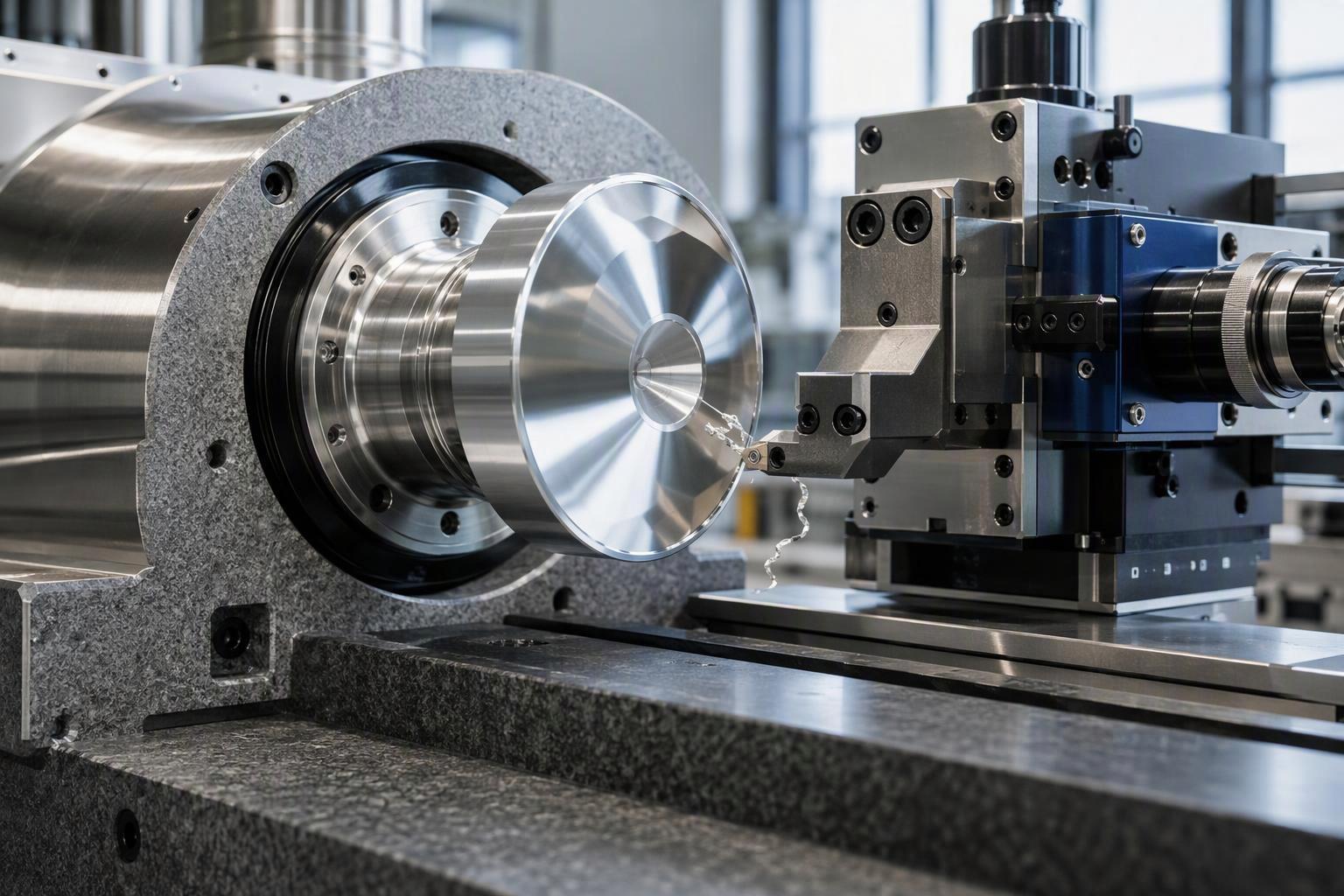
Diamond turning matters because it produces specular, non-ferrous optical surfaces in a single setup, where grinding and polishing typically need several. That single-setup capability is what makes the process the enabling step for infrared optics, freeform surfaces and diffractive structures that are difficult or impossible to generate by lapping one surface at a time.
The process is demanding rather than forgiving. NASA's preferred-practice guidance for diamond-turned aerospace optics states that "meticulous control of vibration, environmental factors, and machining parameters are required to produce precision diffractive, refractive, reflective and hybrid optical components for aerospace applications." In other words, the machine, the room and the cutting parameters all sit inside the same error budget, and the achievable surface is set by the weakest of them.
Diamond turning applications cluster where a reflective or transmissive surface must be specular as cut, without a subsequent polishing step. Copper, aluminium and brass mirrors are the classic case, and the same approach covers infrared and visible optics, contact lens molds, laser components and aerospace optical systems.
The aerospace examples show why the process earns its place. NASA's practice series documents diamond turning as the route to rugged, temperature-compensating achromatic precision optical elements, a combination that is hard to assemble from separately ground and polished parts.
Diamond turning removes material in ductile mode at a depth of cut measured in fractions of a micrometre, using a single-crystal diamond tool ground to a cutting edge radius of tens of nanometres. The chip forms by plastic deformation rather than brittle fracture, so the tool leaves a surface that is optical as cut, with no polishing step after it.
The machine around the tool has to hold it steady to a tolerance smaller than the chip it removes. Air-bearing spindles run with axial and radial error motions around 0.1 µm, slideways are lapped to roughly 0.5 µm straightness over any 150 mm of travel, granite bases damp vibration, and position feedback resolves better than 10 nm with glass scales or better than 2 nm with laser interferometers, as described in this overview of diamond turning machine design.
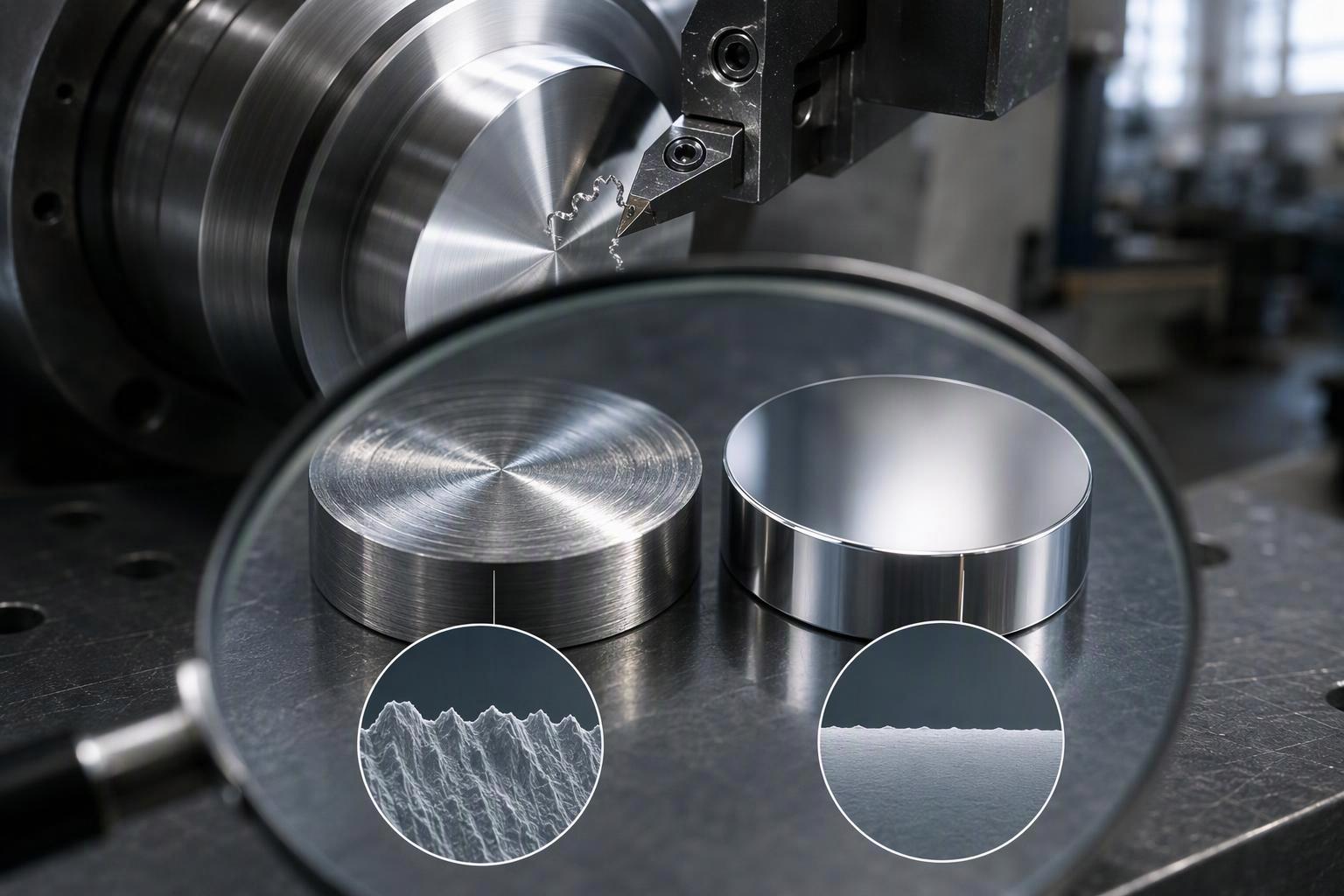
Achievable finish in diamond turning is theoretically limited by the cusps a round-nosed tool leaves behind, and feed rate sets their spacing. Lowering the feed rate produces a finer cusp pattern, but it is also a key determinant of process cost, so the trade-off between feed rate and achievable finish is a commercial decision as much as a technical one.
Tool geometry comes next. Rake angle and tool radius need optimizing for the specific workpiece material rather than selected from a general chart. Depth of cut and surface speed affect tool wear and, in some cases, finish, though reported work finds surface speed has minimal impact for most diamond-turnable materials.
Vibration is the input that is hardest to see. Spindle rotation generates high dynamic forces, mostly synchronous with spindle rotation, with asynchronous components arriving from air-pressure pulsation and motor-amplifier electrical noise. Those asynchronous components do not repeat with the spindle, so they show up as irregular texture rather than a predictable pattern.
For diamond-machinable materials, the peer-reviewed range for diamond-machined surface roughness sits at roughly 1 to 10 nm Sa, as reported in the ASME review of the process. Better results are documented in specific applications: one machine builder reports sub-1 nm Sa finishes and sub-0.1 µm peak-to-valley form accuracy on aerospace optics, and measured finishes reported for diamond-turned infrared optics come in around 5 nm Ra/RMS. A manufacturer reports 6 nm on a high-refractive-index polymer processed by a related technique.
Treat those as process-class capability figures rather than a specification you can copy across. Finish and form both depend on the geometry being cut, the material, and the machine condition, and the vendor figure in particular comes from a builder testing its own equipment.
⚠️ Warning: These figures describe what the process class can reach. They are not a guarantee for a given part, material, or machine.
The standard definition of diamond turning is worth keeping in view here: the process produces optical surfaces without additional polishing or buffing for compatible materials, which is the practical claim the numbers above are supporting.
Diamond turning is single-point material removal, not a coating step or a polishing stage. The tool is a natural or synthetic diamond with a defined cutting edge, and it removes material one pass at a time, the way any turning operation does. The name invites two wrong assumptions: that the process deposits diamond onto a part, and that it is interchangeable with diamond grinding. It is neither.
In optics manufacturing, diamond turning sits alongside diamond grinding, deterministic microgrinding and polishing as separate processes with different removal mechanisms and different achievable geometries (how diamond turning is defined against other optics processes, 2026). Diamond grinding uses a bonded abrasive wheel with many cutting points; diamond turning uses one. Confusing them leads to specifying the wrong machine, the wrong tolerance and the wrong cost model.
Diamond turning does not work on steel, and the reason is chemical rather than mechanical. Cutting steel generates temperatures that promote strong chemical interactions between the iron in the steel and carbon atoms in the diamond lattice. This reaction results in graphitization and rapid deterioration of the cutting edge, significantly reducing tool life and machining quality (the chemical reason diamond tools wear rapidly on steel, 2026).
The consequence is specific. Grade 420 stainless steel, commonly used for precision optical mold inserts, cannot be directly machined with diamond tools because of this chemical affinity and the tool wear it produces. Early attempts to suppress carbon diffusion by cutting in a carbon-saturated atmosphere provided only marginal improvements. Sapphire has been proposed as a tool material for ferrous work because it is chemically inert to iron and retains high hot hardness, though it is not a drop-in replacement for diamond on non-ferrous parts.
Process selection comes down to material, geometry and volume rather than capability. Diamond turning suits non-ferrous and infrared materials where a single setup and no subsequent polishing decide the outcome, and it is excluded outright on ferrous work. Grinding handles simple flats and cylindrical forms cheaply at volume, polishing adds the final surface where turning alone cannot reach the specification, and molding takes over once production volume justifies the tooling cost (a short definition pitched at a general engineering audience, 2026).
Criterion | Diamond turning | Grinding | Polishing | Molding |
|---|---|---|---|---|
Material fit | Non-ferrous, IR optics, polymers | Ferrous and non-ferrous | Any machined surface | Moldable resins, some glass |
Geometry fit | Aspheres, freeforms, micro-optics | Flats, cylinders, simple curves | Final surface only | Replicated complex forms |
Setup count | One | One to several | Follows prior operation | One per mold, then many parts |
Achievable finish | Optical, as-cut | Fine, not optical | Optical, slow | Replicates mold finish |
Volume economics | Low to medium | Medium to high | Low | High only |
Confirm the material first, because ferrous content rules diamond turning out before any other consideration applies.
Diamond turning suits three broad families of material: non-ferrous metals, plastics, and infrared-transparent crystals.
The metals that machine readily include aluminium and its alloys, copper, brass, gold, silver, tin, zinc, and nickel-phosphorus deposited by electrolytic or electroless plating, according to the list of materials that can be diamond turned maintained on Wikipedia. Plastics on the same list include acetal, acrylic, nylon, polycarbonate, polypropylene, polystyrene, and Zeonex. Infrared crystals cover cadmium sulfide, cadmium telluride, calcium fluoride, cesium iodide, gallium arsenide, germanium, lithium niobate, and potassium bromide.
Practitioner guidance adds magnesium fluoride, zinc sulfide, silver chloride, Rexolite, Topas, Ultem, and Teflon to the machinable set, and states the exclusion plainly: ferrous materials are not easily machinable because the carbon in the diamond tool reacts chemically with the substrate and damages the tool, as a manufacturer's explanation of why ferrous parts are excluded sets out.
The process is live and still widening. Fast-tool servo variants extend single-point diamond turning from rotationally symmetric surfaces to freeform optics, and sapphire and other hard-material work continues to expand the machinable set, as how diamond turning is defined against other optics processes describes.
Pro Tip: The practical gains are concentrating in two places: hybrid workflows that additively build a near-net form and then diamond turn the final surface, and in-process metrology that measures form while the part is still on the machine. Both reduce the number of setups between cutting and verification. Treat this as direction of travel rather than settled practice; published, methodologically transparent performance figures for either remain scarce.
Explore further reading on process parameters and material selection
Go deeper on cutting parameters, tool geometry, and how to match a material to a process route.
Read the guide
Yes. Single-point diamond turning (SPDT) is the precise name for the same operation: one single-crystal diamond tool with a continuous cutting edge removes material in a controlled pass. "Diamond turning" is the short form used across industry and academia, so either term in a specification points to the same process.
Not economically. Diamond tools wear rapidly on steel and other ferrous metals because the carbon in the diamond reacts chemically with the iron in the workpiece, degrading the cutting edge far faster than the mechanical wear seen on non-ferrous metals. Ferrous parts are normally finished another way.
Smooth enough for optics: diamond turning routinely produces surfaces measured in nanometers of roughness, which is why it serves mirror and lens production rather than general machining. The exact figure depends on the machine, tool, and material, so any single number is specific to the setup it was measured on.
Per-part cost is driven mainly by how slowly the tool must move across the workpiece. A finer finish requires a lower feed rate, which lengthens cycle time and raises cost, so the trade-off between feed rate and achievable finish is the main lever on price. Simple geometry at a moderate feed rate costs far less than a freeform surface held to a tight tolerance.
Usually not. Diamond turning leaves a finished optical surface directly from the cutting pass, which is why it replaced the grind-and-polish sequence for many rotationally symmetric optics. Polishing is added only when the specification calls for a finish beyond what the cutting pass delivers.
Diamond turning removes material with a single-point cutting edge, producing a continuous chip and a surface that needs no further finishing. Diamond grinding uses a bonded abrasive wheel with many cutting points and removes material by abrasion instead. That distinction, single-point cutting versus abrasive removal, is how diamond turning is defined against other optics processes.
Diamond turning is an ultra-precision machining process that cuts material with a single-crystal diamond tool on a lathe built for sub-micrometre control, producing optical-quality surfaces directly from the cut. Whether it fits a job comes down to three things: material compatibility, achievable finish and form, and cost.
Material compatibility comes first. Diamond tools wear rapidly on steel and other ferrous metals for a chemical reason rather than a hardness one, so those parts usually belong on a different process. Finish and form set the second limit: the standard definition of diamond turning only pays off when the part genuinely needs nanometre-scale surface roughness or tight form accuracy, because conventional turning is cheaper wherever it meets tolerance.
Cost then follows the trade-off between feed rate and achievable finish. Slower feeds buy finer surfaces and consume more machine time, so the right parameters depend on the specification the part actually has to meet.
If you are weighing the process for a specific part, the useful next step is to compare your material and tolerance against what the process delivers. Learn more about process parameters and material selection before you commit a design to it.


